


How Much Should You Feed Your Cat? Portions, Feeding Schedules and Nutrition Basics
Feeding your cat the right amount is about more than filling a bowl. Too much food leads to weight gain, which raises the risk of diabetes, arthritis, and other problems, while too little leaves a cat thin, hungry, and short on nutrients. The right amount depends on your cat's ideal weight, age, activity, and the calories in the food you use. This guide gives you a calorie chart by weight, shows how to turn calories into cups and cans, explains how to check whether you are feeding enough, and covers feeding schedules, food types, safe diet changes, and food allergies.
If you have ever wondered whether you are feeding your cat enough, start with the chart below, then let your cat's body condition guide small adjustments. This is general guidance; cats with diabetes, kidney disease, or other health conditions should follow their vet's feeding plan.
Cat feeding and nutrition guides by topic
This page covers portions and the basics of feeding. Each guide below goes deeper on one question.
Feeding schedules and appetite
- Gradual feeding schedule changes: how to move mealtimes in small steps and stop early-morning begging.
- Circadian rhythms and digestive timing: why cats are most active around dawn and dusk, and what that means for meal timing.
- When increased appetite deserves attention: how to confirm a cat is really eating more and which patterns need a vet.
Food types, storage and safe transitions
- How long can wet cat food sit out?: a practical removal deadline for uneaten wet food and how heat changes it.
- How to keep wet cat food fresh after opening: covering, refrigerating, and when to throw an opened can away.
- Freeze-dried vs. air-dried vs. baked cat food: how processing differs between these formats and what to weigh when choosing.
- Calcium and phosphorus in raw feeding: why mineral balance matters so much in raw and homemade diets.
- Slow diet transitions for a sensitive gut: mixing schedules and the signs that mean you should slow down.
Food allergies and sensitive digestion
- Food allergy vs. food intolerance: how the two differ and why an elimination diet is the way to tell.
- The elimination diet, step by step: choosing a trial diet, avoiding hidden extras, and reintroducing foods.
- What is hydrolyzed protein?: how hydrolyzed diets work for cats with suspected food allergies.
- The feline gut-skin axis: how gut health and the immune system connect to itchy skin.
1. Factors That Determine How Much to Feed Your Cat
There is no one-size-fits-all answer when it comes to cat feeding. Several factors come into play:
- Age: Kittens grow fast and need more calories for their size, spread over three to four meals a day. Adult cats usually do well with two or more meals a day. Older cats vary: some slow down and gain weight, while many older seniors lose weight and need more food, not less.
- Weight and body condition: Feed for your cat's ideal weight, not just the current number on the scale. An ideal-weight cat has a visible waist from above, and you can feel, but not see, the ribs. If you are unsure what your cat should weigh, see the average healthy cat weight and ask your vet.
- Activity level: Indoor cats that nap most of the day burn fewer calories than active or outdoor cats, which may need noticeably more food.
- Neutering: Spayed and neutered cats often need fewer calories than intact cats, so watch their weight after surgery.
- Type of food: Dry food is calorie-dense, so small measuring errors add up. Wet food has fewer calories per ounce because so much of it is water. Calories also vary a lot between brands, so always check the label.
- Health conditions: Cats with diabetes, kidney disease, or food allergies often need prescription diets and portions set by a vet.
2. Cat Feeding Chart: Daily Calories by Weight
A common starting point for healthy adult cats is roughly 20 to 30 calories per pound of ideal body weight per day. Individual needs vary a lot, so use these numbers as a starting point and adjust based on your cat's body condition every few weeks.
| Ideal weight | Less active indoor or neutered adult | More active adult |
|---|---|---|
| 6 lb (2.7 kg) | About 150–170 kcal/day | About 170–200 kcal/day |
| 8 lb (3.6 kg) | About 180–210 kcal/day | About 210–250 kcal/day |
| 10 lb (4.5 kg) | About 210–250 kcal/day | About 250–300 kcal/day |
| 12 lb (5.4 kg) | About 250–290 kcal/day | About 290–340 kcal/day |
| 15 lb (6.8 kg), large-framed cat at ideal weight | About 290–340 kcal/day | About 340–400 kcal/day |
These ranges are for adult cats at a healthy weight. Kittens need much more for their size, pregnant and nursing cats need more again, and overweight cats should be fed for their target weight, which works best with a vet-guided plan, because cats should lose weight slowly.
Turning Calories Into Cups and Cans
Every food lists its calories on the label, usually as kcal per cup for dry food and kcal per can for wet food. Divide your cat's daily calories by that number:
- Dry food: Many dry cat foods fall somewhere around 300 to 500 kcal per cup. At 400 kcal per cup, a 10-pound cat needing about 230 kcal would eat a little over half a cup a day, split into meals.
- Wet food: A 3-ounce can often contains somewhere around 70 to 110 kcal, and a 5.5-ounce can roughly 140 to 200 kcal. A 10-pound cat eating only wet food might need around two to three 3-ounce cans a day.
- Mixed feeding: Add the calories from both. For example, half the day's calories from wet food and half from dry.
This is why a fixed rule like "half a can per meal" can be misleading. Half a 3-ounce can twice a day is fine as part of a mixed diet, but it is well short of what most adult cats need if wet food is all they eat.
Treats Count Too
Keep treats to about 10 percent of daily calories, and take them out of the main meals. A few treats a day can add up to a meal's worth of calories in a small cat.
3. General Feeding Guidelines by Life Stage
Kittens (0–12 Months): Tiny Stomachs, Big Needs
Kittens grow fast and burn energy quickly. They need:
- Three to four small meals per day, because their stomachs cannot handle large portions
- A complete food made for kittens or for all life stages, to support growth
- Wet food, alone or mixed with kibble, for moisture and easier chewing
Adult Cats (1–7 Years): Finding the Balance
Most adult cats do well with:
- Two or more measured meals per day; several small meals, closer to how cats naturally eat, also work well
- Roughly 20 to 30 calories per pound of ideal body weight, adjusted for activity
- Free feeding only if weight stays stable, because many cats overeat when food is always available
Senior Cats (7+ Years): Adjusting for Age
Older cats change in different directions, so feed the cat in front of you:
- Mature cats (around 7 to 10) that are gaining weight may need slightly smaller portions.
- Older seniors that are losing weight or muscle often need more calories and good-quality protein; unexplained weight loss needs a vet visit.
- More wet food helps with hydration, which matters for kidney health.
The senior cat care guide covers diet changes for older cats in more detail.
4. How to Measure the Right Portion
Guessing leads to slow weight gain or loss. Here is how to do it right:
- Use the label's feeding guide as a starting point only; it is often generous.
- Weigh dry food on a kitchen scale, because scoops and cups vary.
- Work out wet food portions from the calories per can, not from a fixed fraction of a can.
- Weigh your cat every two to four weeks and adjust portions by about 10 percent at a time if needed.
- In multi-cat homes, feed cats separately if one eats the other's food.
5. Are You Feeding Your Cat Enough? How to Check
The scale and your hands tell you more than the bowl does. Use the body condition score your vet uses, where 4 to 5 out of 9 is ideal:
| What you see and feel | What it usually means | What to do |
|---|---|---|
| Ribs, spine, and hip bones easy to see or feel sharply; little fat | Underweight | Increase food gradually and see your vet to rule out illness |
| Ribs easy to feel under a thin fat layer; visible waist from above | Ideal | Keep portions steady |
| Ribs hard to feel; waist faint or missing | Overweight | Reduce portions or treats slightly; ask your vet for a target |
| Ribs not felt; round belly; fat over the back | Obese | Work with your vet on a slow weight-loss plan |
Signs of overfeeding: steady weight gain, a disappearing waist, less interest in play, or trouble grooming the lower back.
Signs of underfeeding: weight loss, ribs and spine becoming prominent, low energy, or a cat that seems constantly hungry. Constant hunger with weight loss is also a classic sign of medical problems such as an overactive thyroid or diabetes, so do not assume the answer is simply more food.
For a hands-on routine, the at-home cat health check guide shows how to score body condition and muscle each month.
6. Feeding Schedules, Begging, and Appetite Changes
Cats are naturally most active around dawn and dusk, which is one reason many cats ask for breakfast very early. Regular, predictable mealtimes help, and several small meals can suit cats better than one large one. The guide to circadian rhythms and digestive timing explains the pattern.
If you want to move mealtimes, shift them by small steps over days or weeks rather than all at once, and avoid feeding immediately in response to begging, which teaches a cat that meowing works. See gradual feeding schedule changes for a step-by-step plan.
A sudden or lasting increase in appetite is different from ordinary begging. If your cat is eating much more than usual, especially with weight loss, more drinking, more urination, vomiting, or diarrhea, contact your vet. A cat that stops eating for more than a day also needs a vet, because going without food can lead to serious liver problems in cats. The guide on signs that a cat's increased appetite deserves attention explains what to watch.
Can an Automatic Feeder Help?
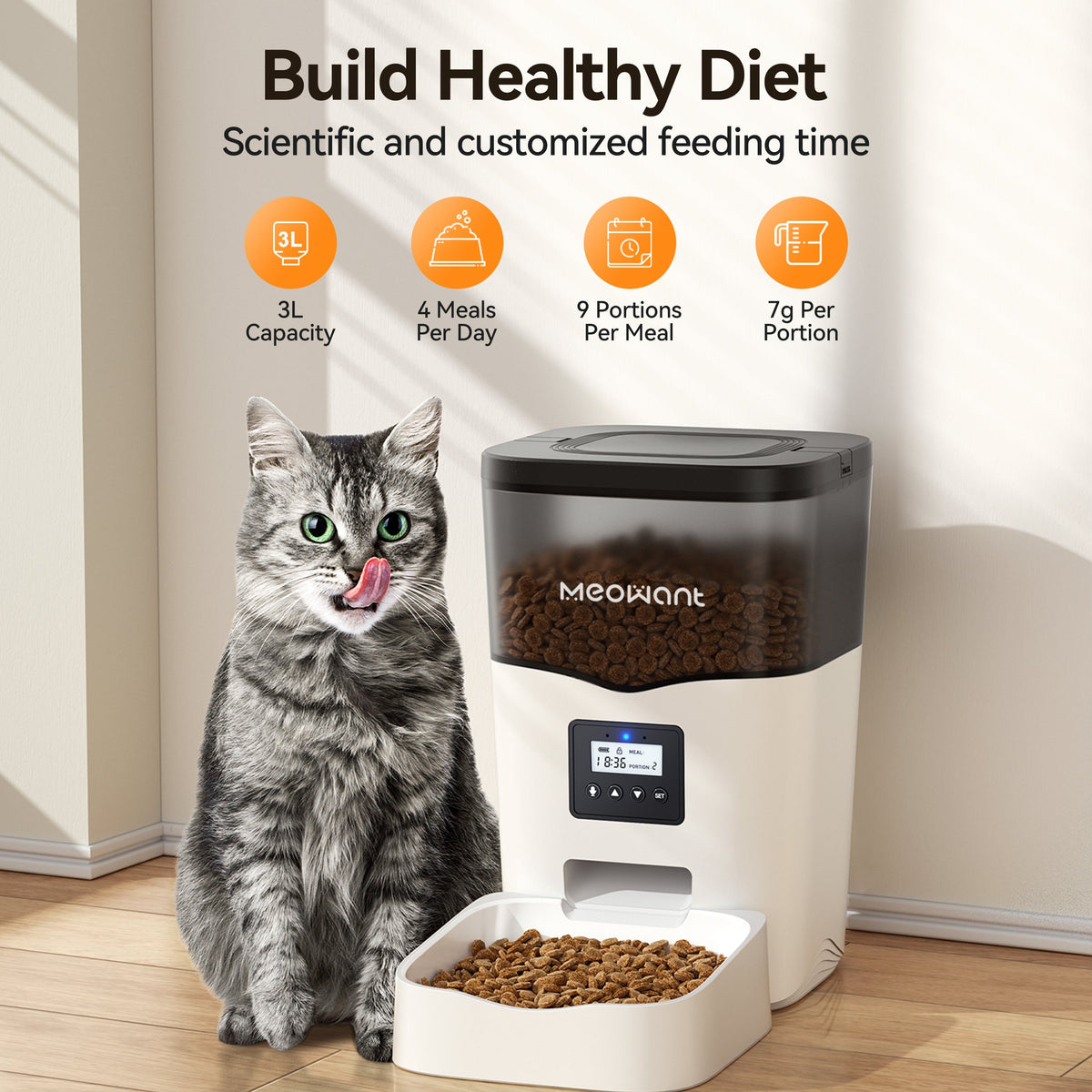
An automatic feeder can help if your schedule makes regular mealtimes hard, if you want to split the day's food into several small meals, or if your cat wakes you for breakfast. It does not decide how much your cat needs; you still set the portion from the calorie chart above. Wet food needs a feeder that keeps it chilled until mealtime, because uneaten wet food should not sit at room temperature for long. For the pros and cons, see are automatic feeders good for cats? If you use one, introduce the feeder without disrupting your cat's meal routine, and plan its timing around your week with a weekly framework for programming a feeder schedule.
7. Wet Food, Dry Food, and Other Food Types
Any complete and balanced food labeled for your cat's life stage can meet their nutritional needs. The choice between types is about moisture, calories, cost, and what your cat will eat.
- Wet food: High in moisture, which helps hydration and urinary health, and lower in calories per bite. It spoils faster once opened.
- Dry food: Convenient and calorie-dense. Measure carefully, and make sure your cat drinks enough water.
- Mixed feeding: Many owners combine both to balance moisture, cost, and convenience.
- Freeze-dried, air-dried, and baked foods: Formats differ in processing, texture, and price. Freeze-dried and air-dried raw products can carry harmful bacteria, so handle them like raw meat. See freeze-dried vs. air-dried vs. baked cat food.
- Raw and homemade diets: These are easy to get wrong, especially the balance of calcium and phosphorus, which affects bones and kidneys. If you want to feed one, work from a recipe formulated by a board-certified veterinary nutritionist. The guide to the calcium-to-phosphorus ratio in raw feeding explains why.
Storing Wet Food Safely
Remove uneaten wet food within about an hour of serving, or sooner in a warm room or if the label says so. Cover opened cans or pouches, refrigerate them promptly, and throw away opened food after 72 hours even if it has stayed in the fridge. Many cats prefer food that is not fridge-cold, so let the next portion sit out for a few minutes or add a splash of warm water. For details, read how long wet cat food can sit out and how to keep wet cat food fresh after opening.
8. Changing Your Cat's Food Safely
Sudden food changes are a common cause of vomiting, diarrhea, and food refusal. Switch gradually over about 7 to 10 days, and longer for cats with sensitive stomachs:
| Days | Old food | New food |
|---|---|---|
| 1–3 | About 75% | About 25% |
| 4–6 | About 50% | About 50% |
| 7–9 | About 25% | About 75% |
| 10 | 0% | 100% |
Mix the foods well rather than layering them. If stools soften or your cat eats less, go back a step and slow down. Never let a cat go hungry to force a change. The guide to slow transitions for a sensitive gut has longer schedules for cats that need them.
9. Food Allergies and Sensitive Digestion
Some cats react badly to certain foods. Vets separate two types of reaction:
- Food allergy: An immune reaction, usually to a protein the cat has eaten before, such as chicken, beef, or fish. It often shows up as itchy skin, especially around the head and neck, and can also cause vomiting or diarrhea.
- Food intolerance: A non-immune reaction, such as trouble digesting a certain ingredient, which mainly causes digestive upset.
The two can look similar, and blood or hair tests are not reliable for diagnosing food allergies in cats. The standard approach is an elimination diet: feeding only a novel-protein or hydrolyzed diet chosen with your vet for about 8 to 12 weeks, with no treats or other foods, then reintroducing old foods to see whether signs return. Read the difference between food allergies and food intolerance in cats, the elimination diet step by step, and what hydrolyzed protein is before you start.
Gut health and skin health are also linked through the immune system, which is one reason digestive and skin signs often appear together; see the feline gut-skin axis. Food is also one piece of managing conditions such as feline diabetes, where your vet will usually recommend a specific diet and feeding routine.
FAQs
Q1. How Much Wet Food Should a Cat Eat Per Day?
It depends on the calories in the food and your cat's ideal weight. As a rough guide, a 10-pound adult cat eating only wet food often needs around two to three 3-ounce cans a day. Check the calories on your food's label and adjust based on body condition.
Q2. How Many Times a Day Should You Feed a Cat?
Kittens need three to four meals a day. Most adult cats do well with at least two meals, and several smaller meals can suit them even better. Keep the total daily amount the same however you split it.
Q3. Is It Okay to Free-Feed a Cat?
Some cats keep a steady weight with food always available, but many overeat. Measured meals make it easier to control weight and to notice early if your cat's appetite changes.
Q4. Why Is a Cat Always Hungry?
Boredom, habit, and a low-calorie or overly restricted diet are common reasons. But constant hunger, especially with weight loss, can be a sign of an overactive thyroid, diabetes, or intestinal disease, so mention it to your vet.
Q5. How Long Should a Diet Change Take?
About 7 to 10 days for most cats, mixing more of the new food in every few days. Cats with sensitive stomachs may need two to three weeks.
Final Thoughts: Feed Smart, Adjust as Needed
There is no magic number for every cat. Start with the calorie chart and your food's label, measure portions, count treats, and check your cat's body condition every few weeks. Small, steady adjustments work better than big changes. And if your cat's appetite or weight changes without an obvious reason, that is a reason to call your vet, not just to change the portion.
